The U.S.-Russia Rivalry in the Middle East
Source: tlaxcala-int.org
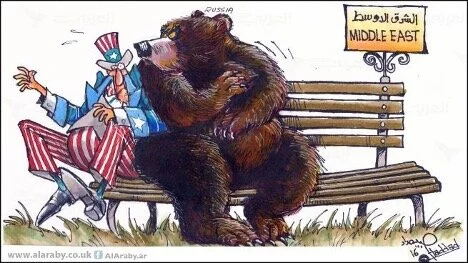
Following the end of the Cold War, the U.S.-Russia rivalry in the Middle East subsided until Russia intervened military on behalf of the Syrian Regime in 2015. This marked Russia’s return as a major power broker in the Middle East. For over half a decade Russia has continually and actively supported the Assad Government through arms, finances and, most importantly, direct military intervention. On the other hand, the U.S. has armed and financed the opposition and supported it through limited military airstrikes conducted against government-held territories.
Russia holds a diverse set of interests in the region. Syria was under the Soviet sphere of influence during the Cold War and remains Russia’s closest and arguably only constant ‘ally’ in the Middle East. Moreover, Russia has for long desired access to a warm water port by the Mediterranean. Syria is the only Middle Eastern nation by the Mediterranean which is outside the U.S. sphere of influence and therefore provides Russia with its best access to warm waters.
Source: tgme.org
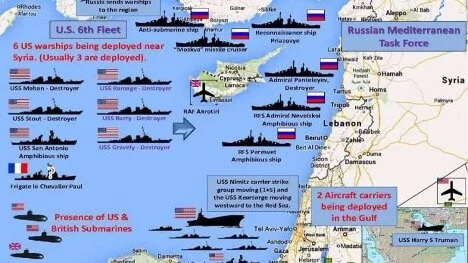
Throughout the course of the Syrian Civil War, Russia has strengthened its military, commercial and economic footprints in the Middle East by establishing a naval base in Tartus and an airfield in Latakia, two coastal Syrian regions. Russia is positioning itself as a powerful actor in both Middle Eastern and Eastern Mediterranean affairs, two regions with an abundance of natural resources. Russia’s decision to undertake a unilateral policy and strategy towards Syria is driven by a global calculus to shift the geopolitical balance of power towards a multipolar international system. Russian policy towards the Middle East is also one of prevention: in other words, Russia has long been wary of military, security, political, and economic crises that plague the Middle East would penetrate Russia’s near abroad, in the Caucasus and Central Asia.
The major actors within Russia controlling Mideast policy are President Putin, who makes the final decisions, and his Minister of Foreign Affairs Sergey Lavrov, who carries out Russian policy in the region. Putin has taken advantage of the United States’ endless wars in the region, which has drained the U.S. treasury, to assert his influence. Russia is acting as a regional power broker by establishing ties with both Iran and Saudi Arabia, and with Israel and Palestine.
The U.S. has positioned itself as the dominant force in the Middle East since the end of the Cold War. It has secured its three primary interests in the Middle East: access to cheap and unlimited oil, the prevention of a rival power rising to challenge American hegemony in the region, and ensuring the survival and strengthening of Israel which acts as a de facto American military base. The U.S. has attained these three vital interests by pursuing a double pivot policy: it exercises a soft power approach, whilst also boasting its hard power. Soft power is achieved by providing regional actors with military, economic, and diplomatic aid, and setting up educational and cultural programs. However, the U.S. has not shied away from projecting its vast military force and conducting subversion campaigns or coups (Hegemon).
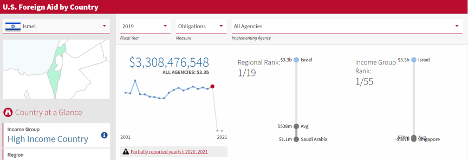
The Six-Day war of 1967 marked a turning point for American foreign policy in the region. The years leading up to the Six-Day war, from 1922 to 1967, saw an intense debate within the establishment between often pro-Zionist members of Congress and elected officials, and pro-Arab State and Defense Department officials. However, Israel’s victory in the war ditched the discussions. Today, annual U.S. aid to Israel amounts to roughly $3.3 billion (Support for Israel; U.S. Aid).
Multinational corporations, primarily oil companies, are also major political actors with huge influence over policy towards the Middle East. For example, until the 1973 Arab OPEC oil embargo, the “seven sisters” —the world’s largest oil corporations at the time, five of which were American (Seven) — managed and owned the bulk of the Middle East’s oil reserves. This gave them state-like powers: negotiating terms of taxes, royalties, and published prices with foreign governments.
The Arab OPEC nationalization of the region’s petroleum resources dwindled the production and distribution powers of the “seven sisters” (Oil). Nevertheless, their influence has not abated, as providers of technical, technological, and logistical support and assisting local actors in managing their vast natural resources.
Another key player that influences U.S. Mideast strategy is the military industrial complex, whose manufacturing and monetary muscle within the American domestic economy allows defense contractors to either directly sell weapons to Middle East regimes or to export arms through the Department of Defense (industry).
About the Author

Simon Nasr
My name is Simon Alexander Nasr, I am both Danish and Lebanese. I am a student of international politics, I have a BA with honors in Political Science-International Affairs from the Lebanese American University (LAU) and an MA in Geopolitics, Territory and Security from King’s College London. I completed an internship program at the United Nations and wrote three articles that were successfully published for the Voice of International Affairs (VOIA). Within the realm of International Relations and Geopolitics, my interests and specialties lie in contemporary Middle East affairs, modern and ancient Middle East history, Foreign Policy and Great Power Politics.
Linkedin: https://www.linkedin.com/in/simon-alexander-rasmussen-nasr-892b1a141/